Single-Slit Diffraction
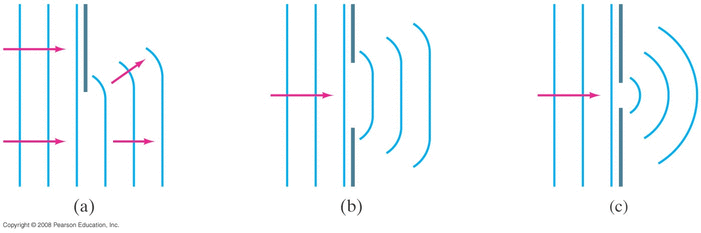
Short video of water waves encountering single and double slit openings in a barrier
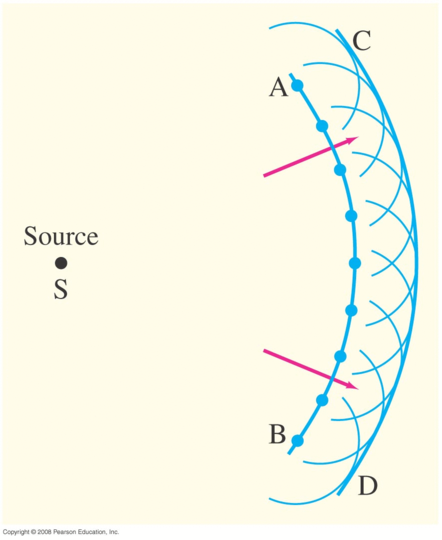
Huygen's wavelets process
Examples
|
Chapter 35 : Diffraction |
Single-Slit Diffraction | |
|
Short video of water waves encountering single and double slit openings in a barrier
|
|
| Huygen's wavelets process
|
|
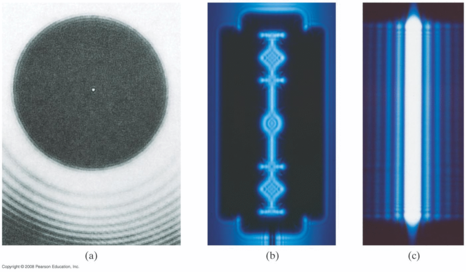
Examples | |
|
|
|
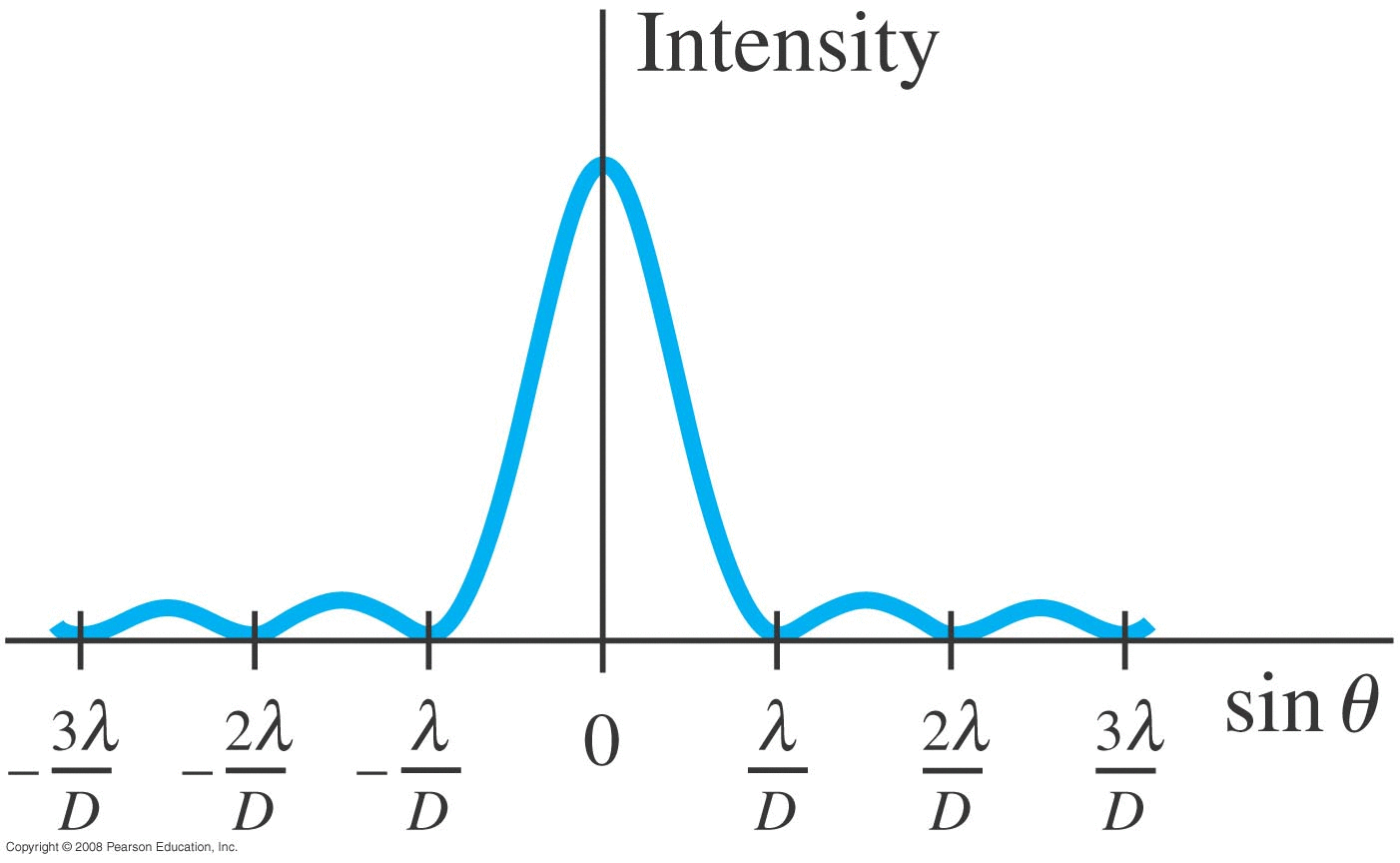
Single Slit Diffraction : Intensity Pattern | |
|
|
|
|
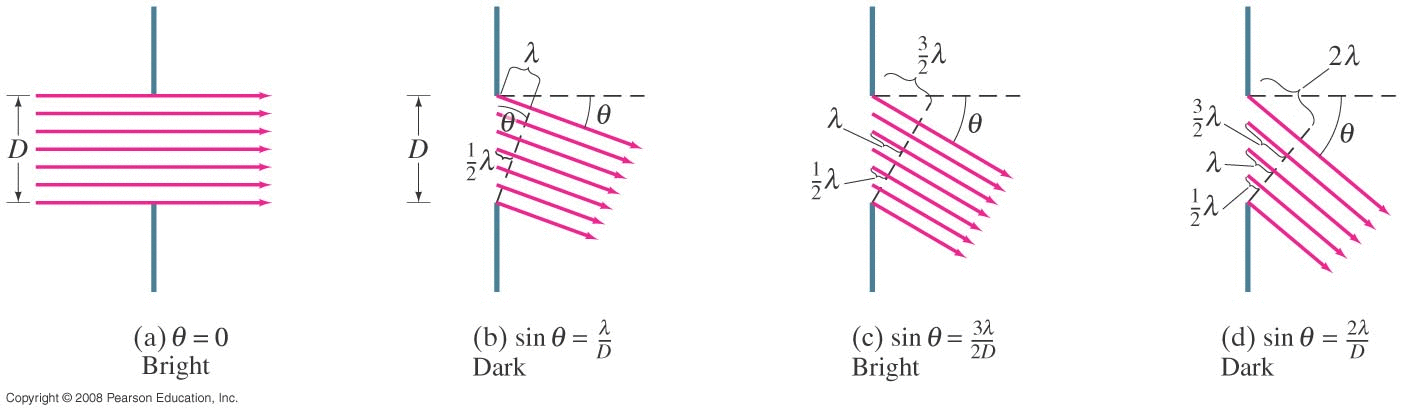
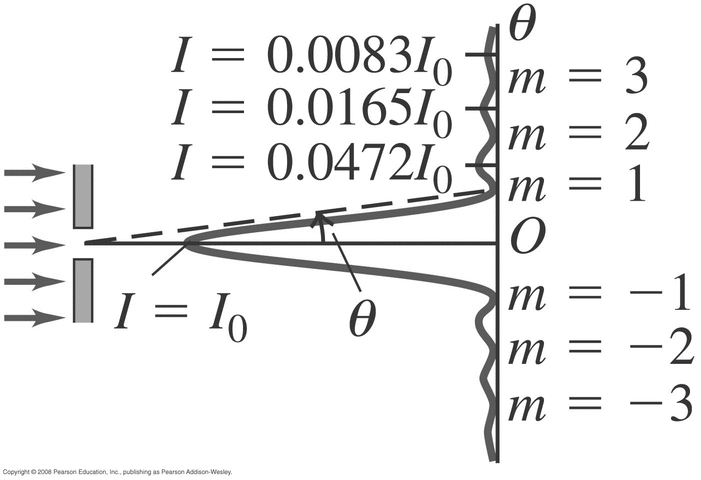
DARK fringes at D sin(θ) = mλ for m=±1,±2,... BRIGHT at θ=0 and (roughly) midway between the dark lines
|
|
|
Derivation and introduction to the sinc function
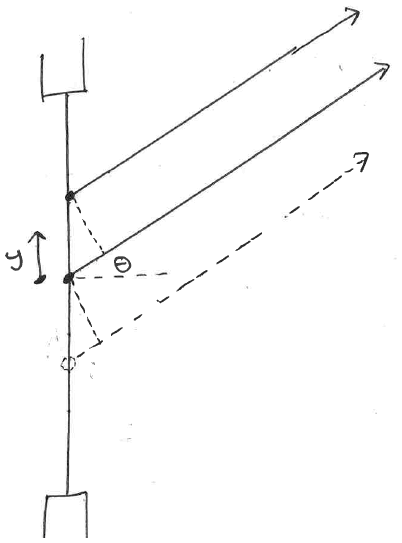
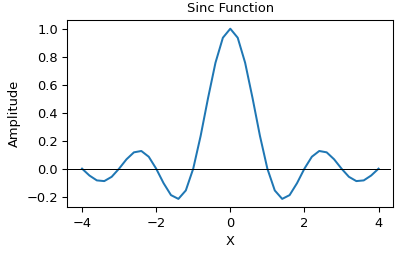
What lands on the screen/film 'far away' to the right will be the sum (integral) of all the 'rays' at a particular angle. Using the middle ray as a reference, all these are basically sine waves shifted by some phase: E ∝ sin(ωt+φ) Relate φ to y and then integrate over y from -D/2 to +D/2 Physical offset: y sin(θ) Equivalent phase shift: φ = ( y sin(θ) ) * (2π/λ) = αy where α=2πsin(θ)/λ Expand sin(ωt+φ) : \[ \sin{ ( \omega t + \phi ) } = \sin{(\omega t)}\cos{\phi} + \cos{ ( \omega t ) }\sin{\phi} \] We're integrating over y from -D/2 to +D/2 so integrating over a phase shift from -(something) to +(same thing) The sin(φ) term will integrate to zero. Basically just left with the total field arriving on the screen being proportional to: \[ \int \cos{(\phi)} dy \hspace{2em} or \hspace{2em} \int \cos{(\alpha y)}dy \] with φ being proportional to y as seen above Resulting E on screen will have an amplitude proportional to: \[ \frac{ \sin{(\beta/2)} }{ (\beta/2) } \] where β = 2 π D sin(θ)/λ That sin(x)/x function is called the SINC function: sinc(x) or snc(x) Intensity will be proportional to amplitude squared, so: \[ I(\theta) = I_o sinc^2 ( \beta / 2 ) \hspace{2em} with \hspace{2em} \beta = \frac{2\pi}{\lambda}D \sin{\theta} \] |
|
Impact on Double-Slit and Diffraction Grating Patterns | |
|
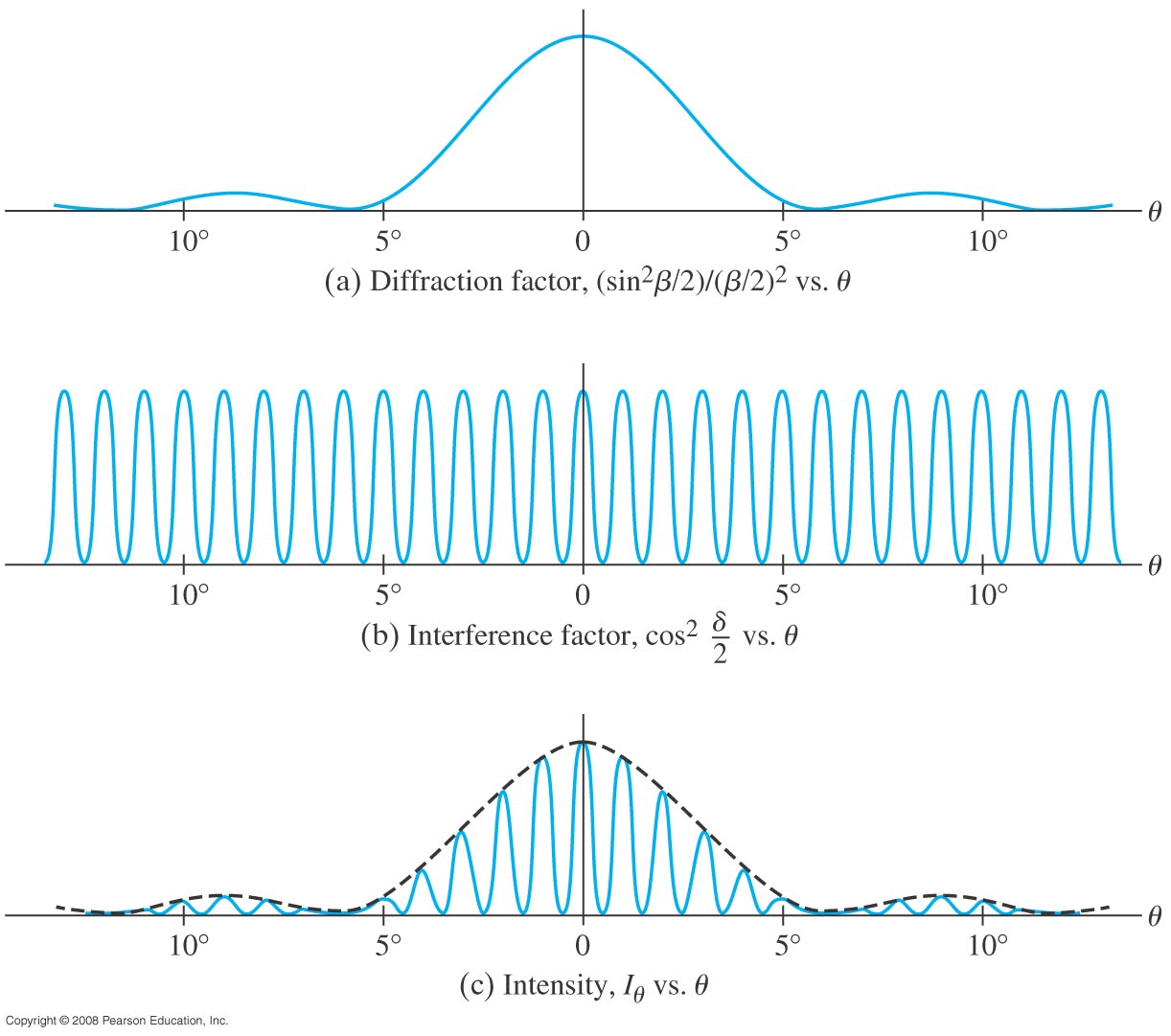
Actual Double-Slit Intensity
|
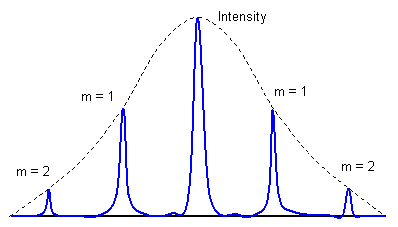
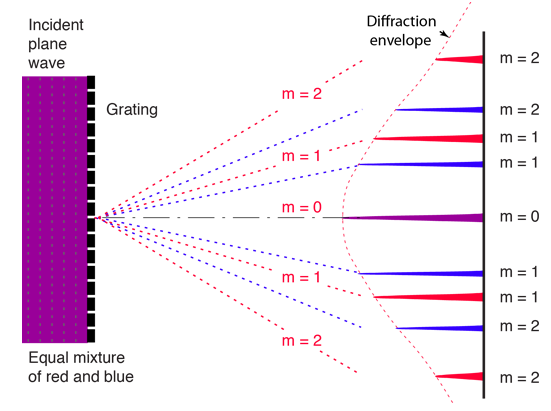
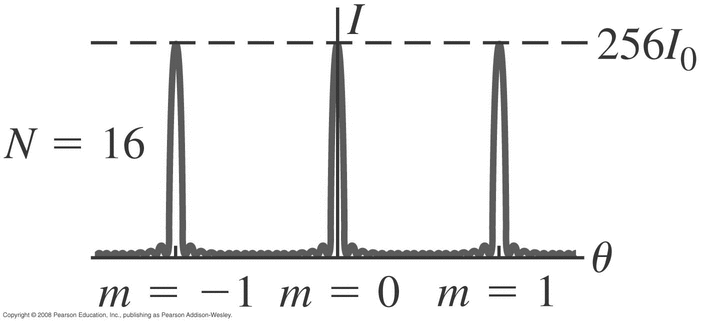
Actual Diffraction Grating Intensity
|
Single Slit Diffraction : Sound Example | |
|
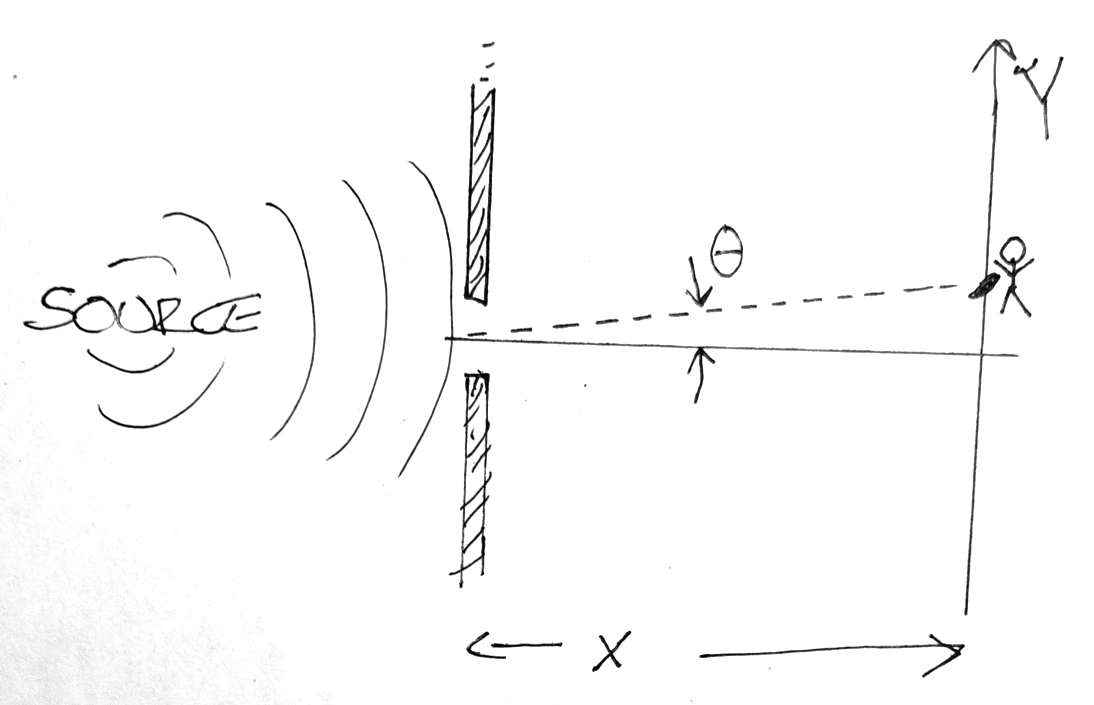
An aircraft maintenance technician walks past a tall (partly open) hanger door that acts like a single slit for sound entering the hanger. Outside the door, on a line perpendicular to the opening in the door, a jet engine makes a 600 Hz sound. At what angle will the technician observe the first minimum in sound intensity if the vertical opening is 0.800 m wide and the speed of sound is 340 m/s? |
|
Inferference and Diffraction | |
|
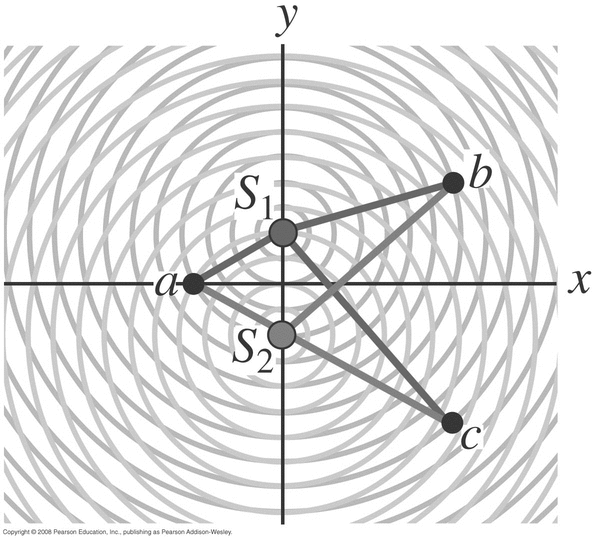
Two-Source (general)
Scenario : Two Sources putting out the same λ in sync with one another • Path Difference: Δs • Constructive: Δs=mλ • Destructive: Δs=(m+½)λ
Wording: • Constructive : bright, strong, loud, ... • Destructive: dark, weak, quiet, ... |
Two-Source (far field)
Condition: R > 10d
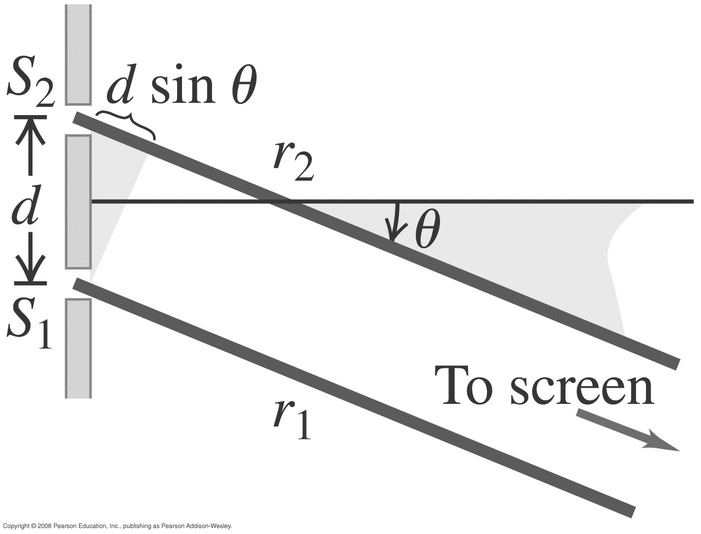
Constructive: d sin(θ) = mλ m=0,±1,±2,... Destructive: d sin(θ) = (m+½)λ m=0,±1,±2,...
Small angle (d>10λ) bright fringes at: \[ y_m = m \frac{R \lambda}{d} \hspace{2em} for \hspace{2em} m=0,\pm1,\pm2, ... \] |
|
Single-Slit Diffraction (Only valid far-field; R>10D)
DARK fringes at D sin(θ) = mλ for m=±1,±2,... If small angle (D>10λ) : \[ y_m = m \frac{R\lambda}{D} \hspace{2em} m=\pm1,\pm2,... \] Intensity: I(θ)=Iosinc2(β/2) where: \[ sinc(x)=\frac{ \sin{x} }{x} \hspace{2em} and \hspace{2em} \beta=\frac{2\pi D\sin{\theta}}{\lambda} \] |
Diffraction Grating (Only valid far-field; R>10d)
Large number of parallel slits separated by d Sharp BRIGHT lines at: d sin(θ) = mλ m=0,±1,±2, ... If small angle ( d>10λ), bright lines at : \[ y_m = m \frac{R \lambda}{d} \hspace{2em} for \hspace{2em} m=0,\pm1,\pm2, ... \] |
Diffraction Grating Examples | |
|
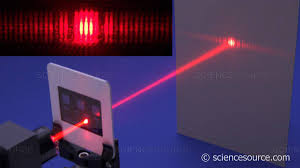
Light: A He-Ne (helium-neon) laser emits a pure wavelength of λ=632.8 nm (red). If we let the laser beam pass through a 1000 lines/mm diffraction grating, what should we see? What is the separation between slits (d)? Constructive interference should occur at: \[ d\sin{\theta} = m\lambda \hspace{2em} where \hspace{2em} m=0,\pm 1,\pm 2, ... \] |
 |
|
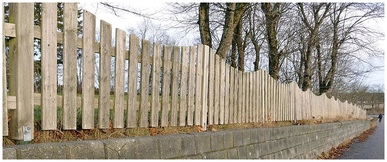
Sound: Somewhere ('far away') on the other side of this picket fence there's a speaker putting out a 6000 Hz tone. The openings in the fence are 15 cm apart. (a) Over on the right side of the fence, at what angles relative to the normal will the sound be especially loud? (Given what the I(θ) pattern looks like for diffraction gratings, this frequency of sound would be very weak at any other locations.) (b) If we stand at the m=1 position for that frequency, what other frequencies will be extra loud there? (c) What frequencies would be missing at that location? |
 |