Chapter 41 : Nuclear Physics and Radioactivity


Atomic and Nuclear Scales

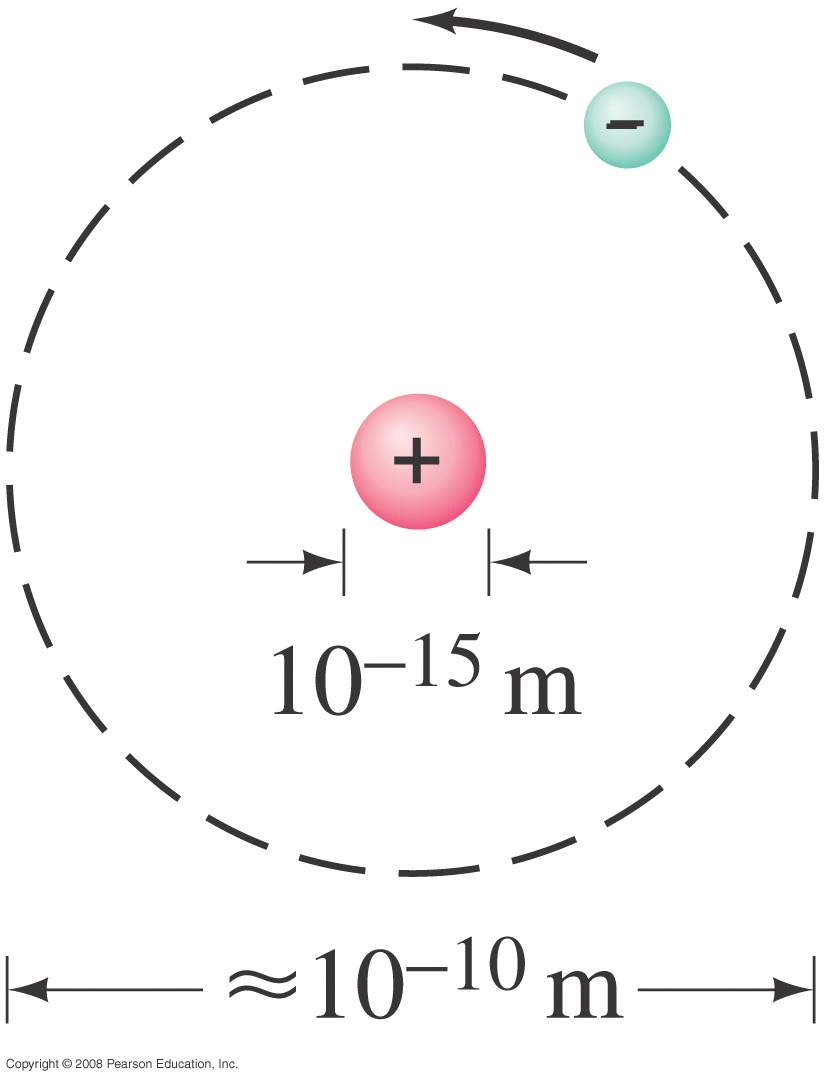
  • Atoms typically on order of 0.1 to 0.4 nm in diameter

  • Rutherford experiment showed nucleus about 10-15 m in diameter (called a femto-meter, or fm)
Strong Nuclear Force

  • Calculate the repulsive electrical force between two protons separated by 1 fm.

  • q=+1e = +1.602 × 10⁻¹⁹ Coulomb

  • mproton = 1.67272 × 10⁻²⁷ kg

\[ F_E = k \frac{ q_1 q_2 }{r^2 } \hspace{2em} with \hspace{2em} k = 8.99 \times 10^9~N \cdot m^2/C^2 \]


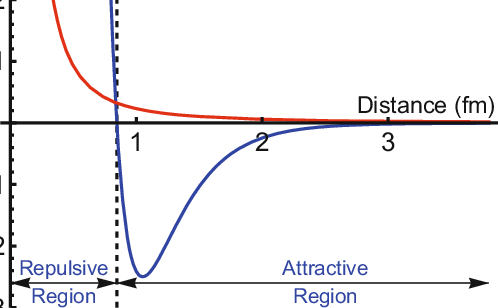
The positively charged protons in the nucleus are repelled from one another by a very large force. They don't (normally) fly apart, so there must be another force (the strong nuclear force) holding them together in spite of this.
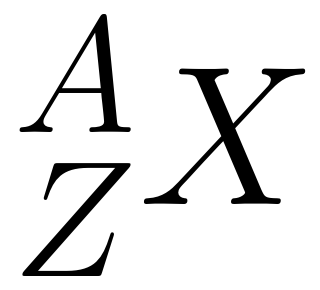
 

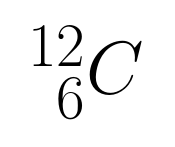
Element Symbols : Isotopes

  • X : symbol for the element (H for hydrogen, etc)

  • Z : the number of protons in the nucleus

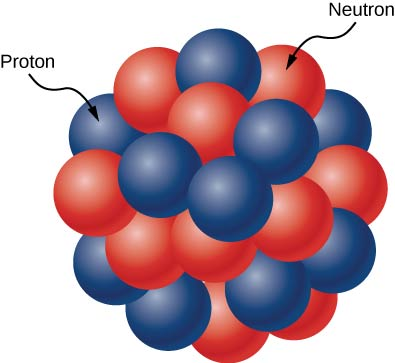
  • A : the number of 'nucleons' (protons plus neutrons) in the nucleus

Example: 'Carbon-12' (6 protons; 6 neutrons)

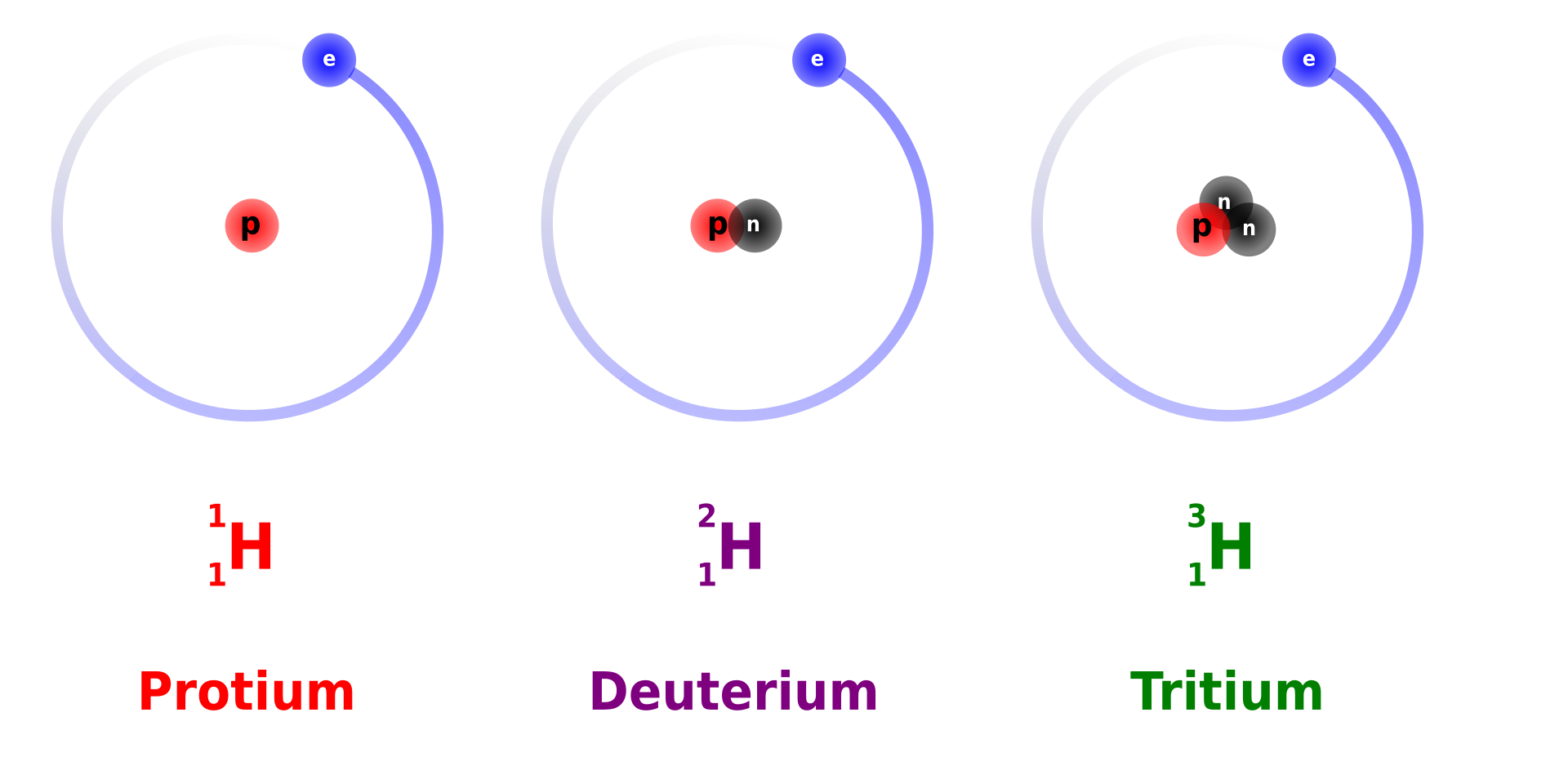
Isotopes of Hydrogen

99.9855%        0.0145%      (trace; unstable)


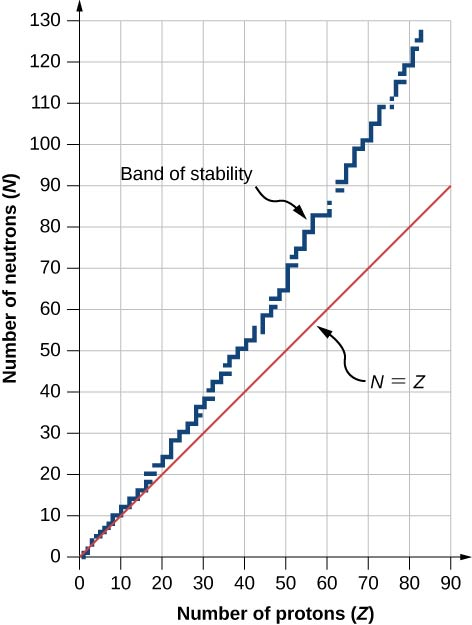
All (Known) Stable Nuclei


  • Most stable isotopes have somewhat more neutrons than protons

  • Helium-3 (2 protons, one neutron) is the ONLY stable isotope with MORE protons than neutrons

  • No element beyond Z=82 (lead) have stable isotopes

  • Technetium (symbol Tc, Z=43 protons) has no stable isotopes

  • Promethium (symbol Pm, Z=61 protons) has no stable isotopes


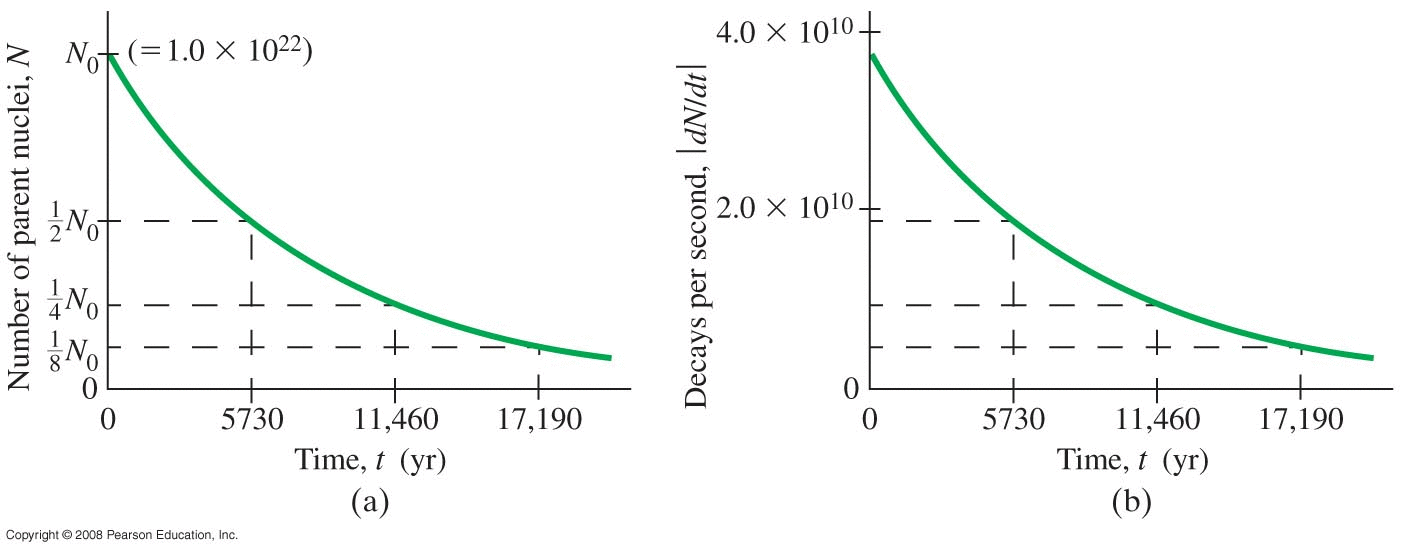
Radioactivty Statistics : Number vs Activity


  • Each atom has a chance of decaying in a time interval

  • Decay constant: λ (the fraction that will decay in a given time interval; units s-1)

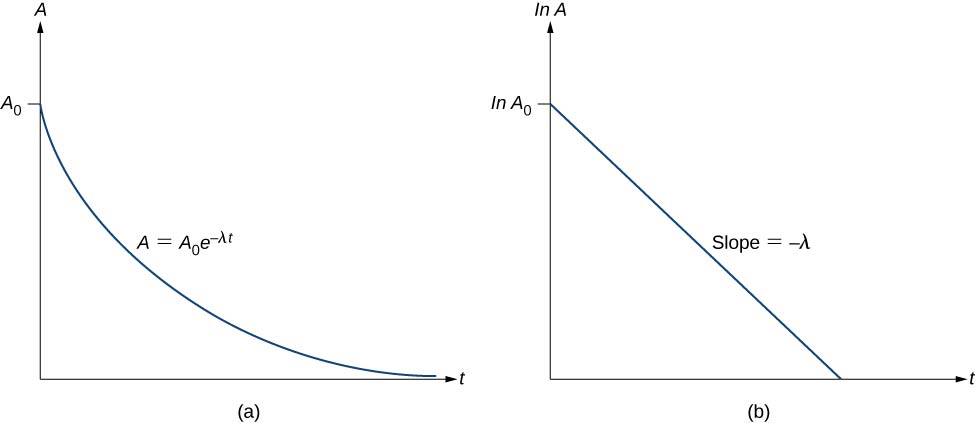
  • SHOW : Number remaining : N(t) = No e-λ t

  • Activity : R(t) = |dN/dt| = |-λ No e-λ t|   or more simply:   R(t) = Ro e-λ t   with   Ro=λNo


Half-life


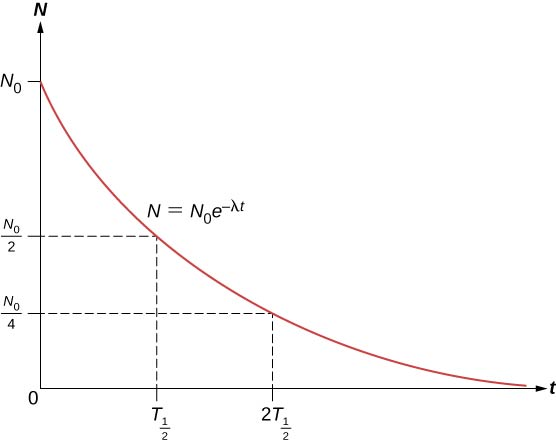
  • Time needed for half to decay

  • N(t)=0.5No at what time?

  • t1/2 = ln(2) / λ


Show the same half-life applies to both:

  • the number remaining (hard to measure)

  • the 'activity' (easy to measure).


EXAMPLE

Carbon-14 has a halflife of 5730 years. Determine it's decay constant λ.

Seconds in a year: 3.154 × 10⁷   (useful shortcut : close to π × 107 sec/year)


What fraction of these atoms are still present after 12,000 years?

   path 1 : finding and using λ

   path 2 : using t1/2 directly

\[ N/N_o = e^{-\lambda t} = e^{-(\frac{ln(2)}{t_{1/2}})t} = e^{-ln(2)*(t/t_{1/2})} \]

\[ but \hspace{2em} x^{ab} = ( x^a )^b \hspace{2em} so \hspace{2em} \]

\[ N/N_o = [ e^{-ln(2)} ]^{( t / t_{1/2} )} = (\frac{1}{2})^{(t/t_{1/2})} \]

\[ N/N_o = [ e^{-ln(2)} ]^{( t / t_{1/2} )} = (1/2)^{(t/t_{1/2})} \]


Common Decay Types (Modes)

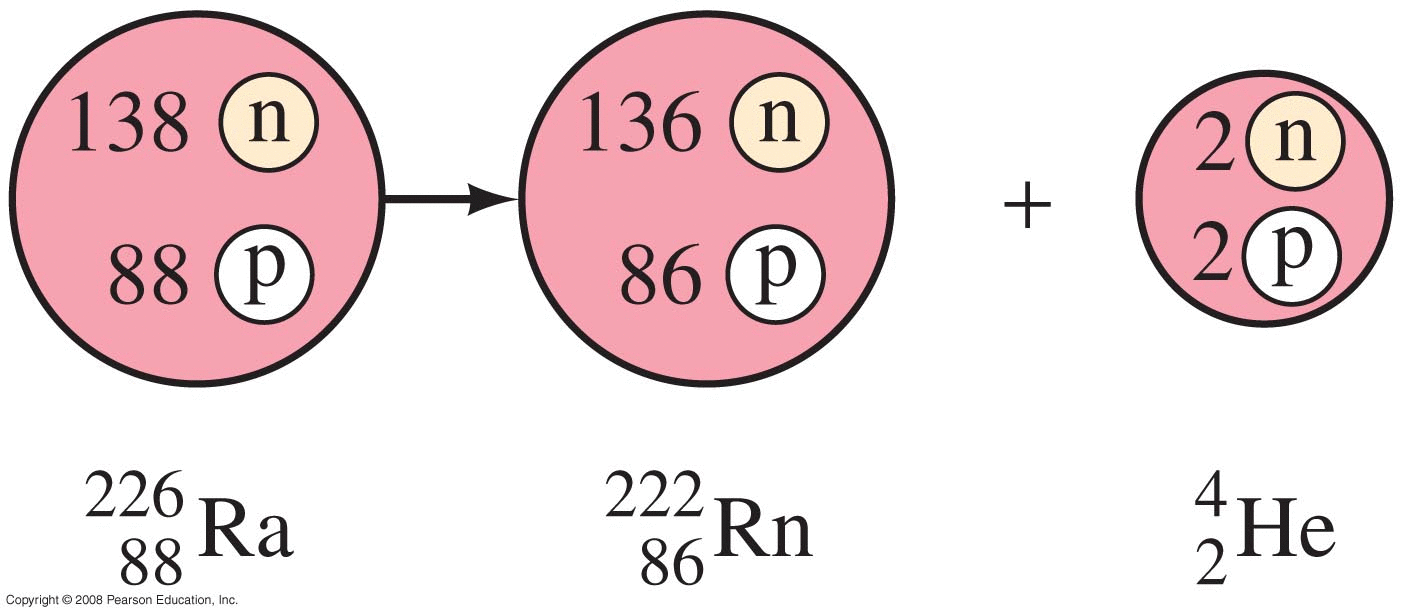
α : alpha decay

  • nucleus ejects part of itself (2 protons and 2 neutrons)

  • here, Radium-226 turns into Radon-222, with a half-life of about 1600 years

(Note: Radon-222 is itself radioactive, decaying via α emission into Polonium-218 with a half-life of about 3.8 days. That polonium nucleus then decays (with a half-life of 3 minutes) into Lead-215, which is also radioactive, ...)

Znew = Z-2     Anew = A-4

β- : beta decay

  • a neutron by itself (outside a nucleus) is not stable

  • it decays into a proton, an electron and an anti-neutrino, with a half-life of about 10 minutes

  • sometimes a neutron inside a nucleus will also decay this way (we'll see more on when this is allowed next time)

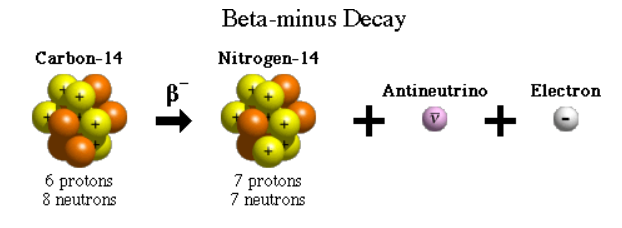
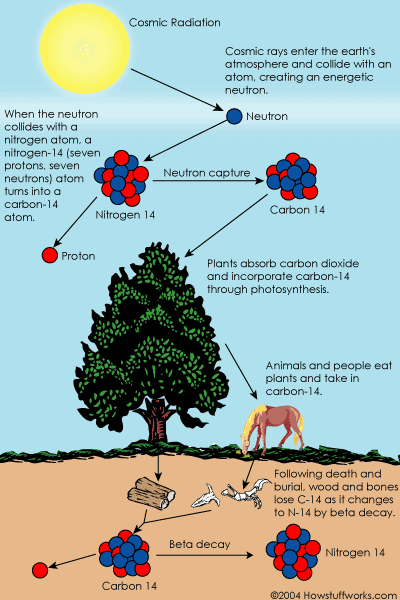
  • Here Carbon-14 decays into Nitrogen-14 (halflife of 5730 years)

\[ n^o \rightarrow p^+ + e^{-} + \bar{\nu} \]

Znew = Z+1     Anew = A

β+ : beta decay

  • the anti-matter version of the electron is the positron

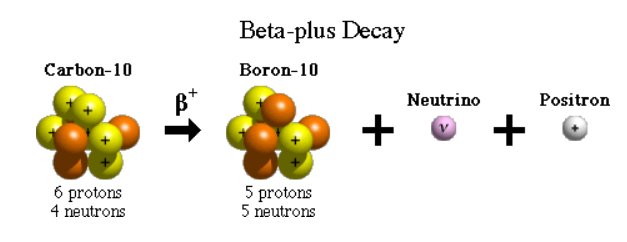
  • sometimes a proton will convert into a neutron, ejecting its positive charge via a positron

  • Here Carbon-10 decays into Boron-10
      (halflife about 19 seconds)

Znew = Z-1     Anew = A

neutron emission

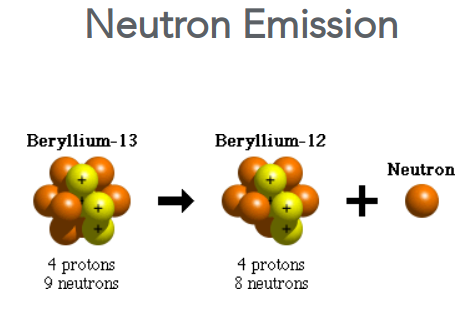
  • here a nucleus ejects one of its neutrons to reach a more stable configuration

  • the number of protons doesn't change, so it's the same element - just a different isotope

  • Beryllium-13 decays into Beryllium-12
      (half-life 2.7 × 10⁻²¹ sec)

  • Helium-5 decays into Helium-4
      (half-life 6.0 × 10⁻²² sec)

Znew = Z     Anew = A-1

proton emission

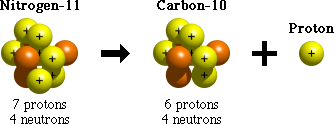
  • here a nucleus ejects one of its protons to reach a more stable configuration

  • ejecting a proton decreases Z by 1, so the resulting element is 'one lower' on the periodic table

  • Nitrogen-11 becomes Carbon-10
      (half-life 585 × 10-24 sec)
    (but see above: C-10 isn't stable either)

Znew = Z-1     Anew = A-1

γ : gamma ray emission

  • sometimes the 'decay product' nucleus is in an excited state and releases a high energy gamma ray as part of the process

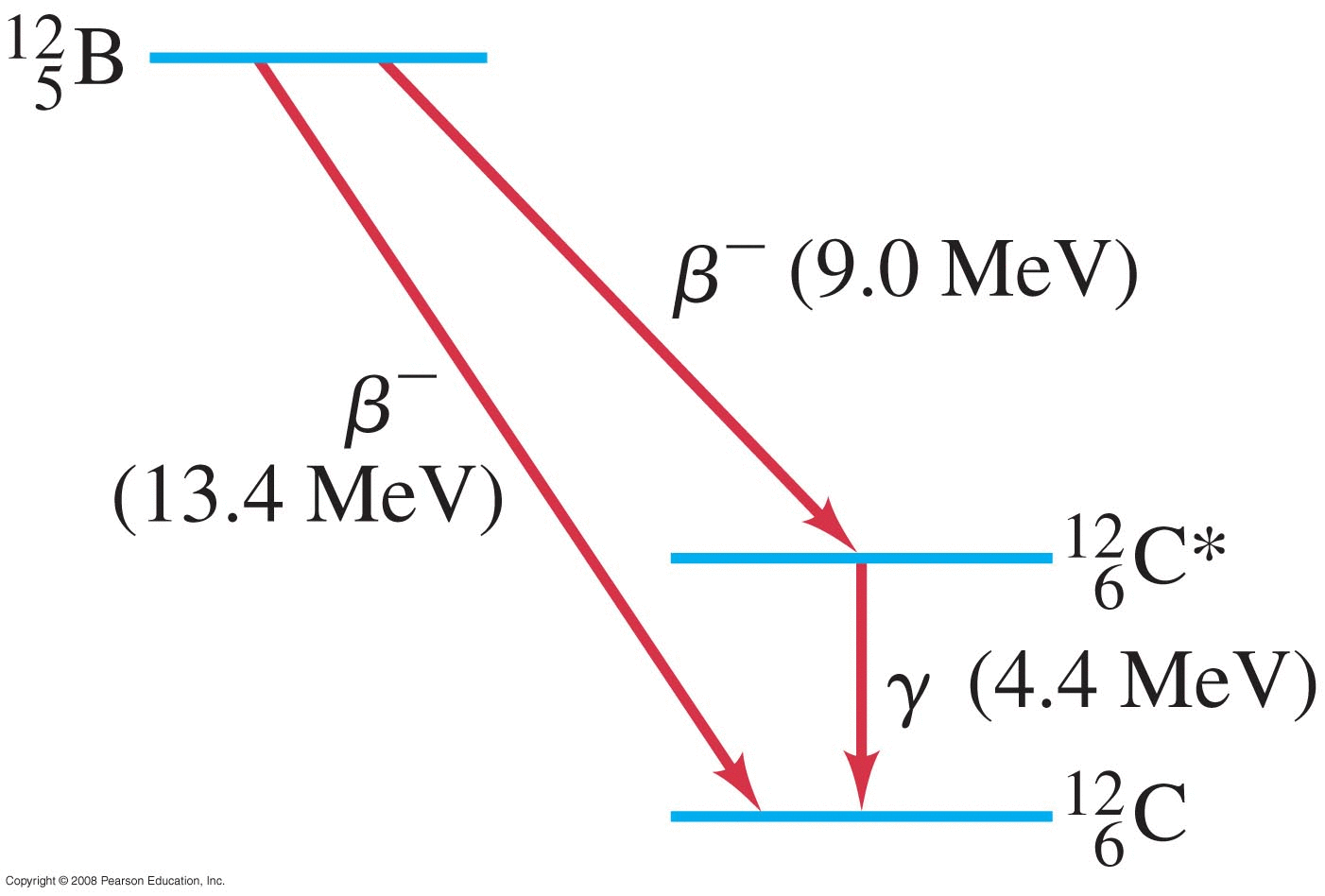
  • Here a radioactive isotope of Boron decays (via β-) into a stable isotope of Carbon, but the carbon nucleus is sometimes left in an excited state and releases the excess energy via a γ ray photon

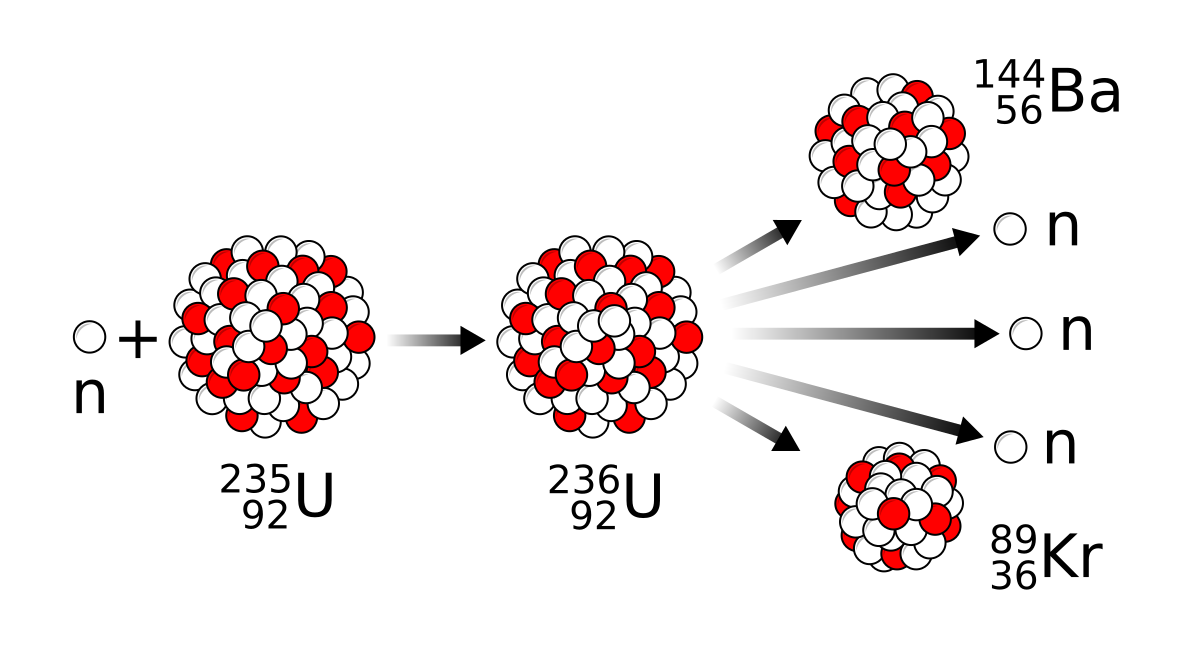
nuclear fission

  • sometimes a nucleus splits into two other elements entirely

  • usually triggered by adding a neutron to an already unstable nucleus

  • resulting reaction may release more neutrons, which can cause even more nuclei to split (chain reaction)

  • Controlled: nuclear reactors


Measuring Radioactivity

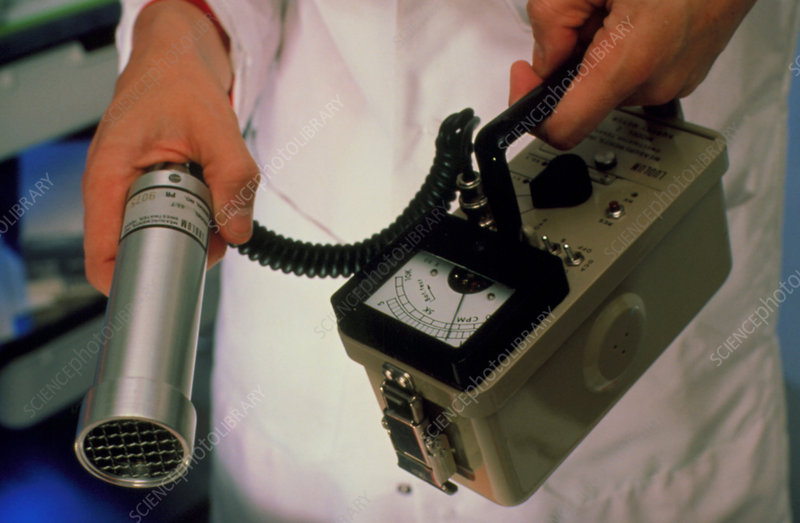
  • Geiger Counter

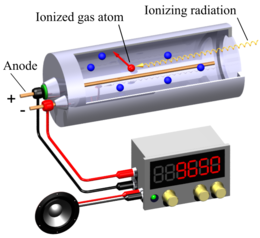
  • Most radiation will be in the keV to MeV range, which easily strips electrons from matter it passes through

  • Can be detected as a brief burst of (tiny) current

  • (Next week's final lab)

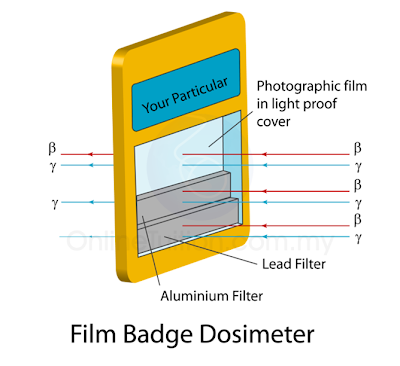
Film Badges

"These are the oldest type of radiation badge and not used by most organizations due to their fragility and the fact that the exposure dose fades over time, making their long-term accuracy unreliable. They consist of a small piece of photographic film inside a light-tight holder. When exposed to radiation, the film darkens. The degree of darkening is proportional to the amount of radiation to which the badge was exposed."

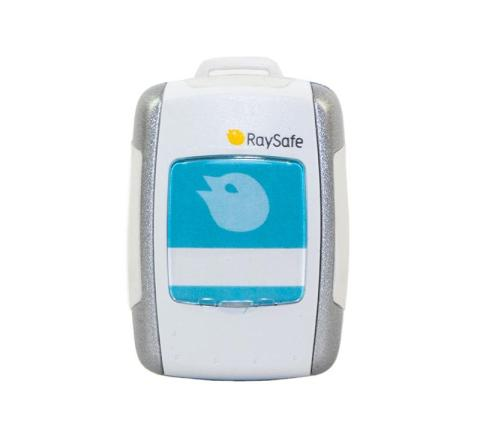
Electronic Dosimeters

"These are the most advanced type of radiation badge. They use electronic components to measure the amount of radiation to which the wearer has been exposed. Some digital dosimeters can be used for realtime monitoring to immediately reduce exposure. Others are able to transmit data wirelessly, eliminating the need for regular badge exchanges. Some have alarms on them to warn the wearer of high levels of radiation."


Example

  • What is the decay constant λ for U-238, which has a half life of 4.5 × 10⁹ years (emits an α particle, becoming an isotope of thorium)

  • If we have 10 grams of U-238, what will its activity be?

  • If we hold a Geiger counter 50 cm away from the sample, how many 'clicks' per second will it read? (Assume the geiger counter has a collection area of 6 cm2)


Atomic weight of U-238 : 238.05078 grams/mole
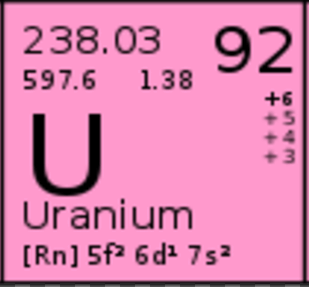
(Why is this different from what's shown for uranium in a periodic table?)

1 mole = 1 NA = 6.02214076 × 10²³ (Avogadro's number)


Suppose we have 10 grams of pure, naturally occuring carbon.

(That would be a little lump of coal about 2 cm across.)


Over 99% will be C-12 and C-13, both completely stable, but about 1 atom in 1012 will be C-14, with a half-life of 5730 years (decaying into N-14 by emitting a β particle)


If we hold the same Geiger counter 50 cm away from this sample, how many 'clicks' per second will it read?
(Clicks/hour would probably be a better unit here...)


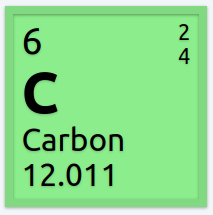
Atomic weight of 'carbon' : 12.011 grams/mole

1 mole = 1 NA = 6.02214076 × 10²³ (Avogadro's number)


Chemical composition of the human body (by weight):

  • 65% Oxygen

  • 18% Carbon

  • 10% Hydrogen

  •  3% Nitrogen

  • 1.4% Calcium

  • 1.1% Phosphorous

  • 1.5% everything else

Average (70 kg) person contains about 7 X 1027 atoms.


Carbon Dating


  • A tiny fraction of the carbon in living matter is Carbon-14, which is radioactive with a half-life of 5730 years

  • Constantly replenished while the plant/animal is alive via breathing and eating

  • After death, whatever was there now just decays away with the given half-life

  • Compare current activity to what it should be to estimate when object died

Example :

Chemical analysis of tiny fragments taken from a 600 gram bone shows that the overall bone contains 200 g of carbon.

A Geiger counter measures a total activity of 16 decays/sec from the bone

The fraction of C-14 in living bone is 1.3 × 10⁻¹²

How old is the bone?


Steps:

  • How much C-14 should the bone have if it were 'fresh'?

  • What activity does that imply?

  • How long would it take to reduce the activity to what we measured?