Chapter 41 : Nuclear Physics and Radioactivity


Common Mass and Energy Units


Atomic Mass Units (amu)

Defined so that a single carbon-12 atom has a mass of exactly 12 u


  • 1 u = 1.660539069 X 10⁻²⁷ kg

  • Energy equivalent: E = mc2 so m = E/c2

  • 1 u = 931.494104 MeV/c2 (931.5 'close enough')

  • Also called a dalton (Da), adopted in 2005


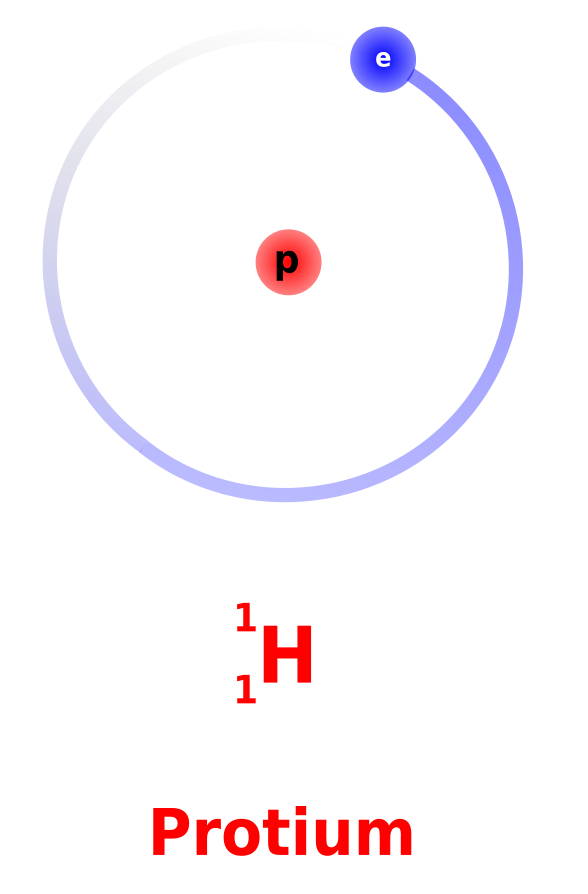
Binding Energy : Atom of Hydrogen-1


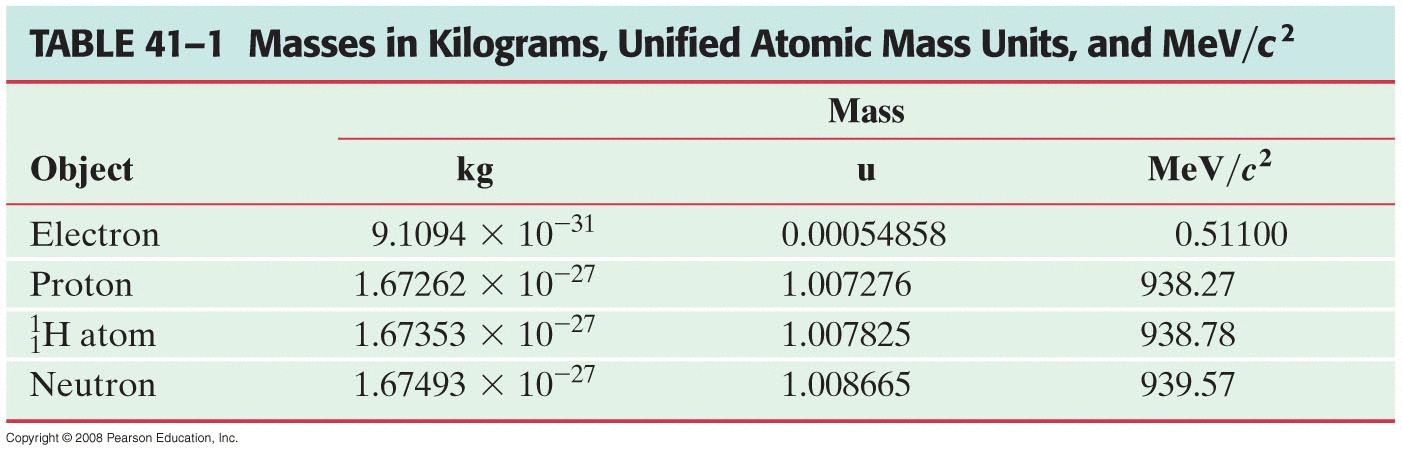
  • Mass of one atom of H : 1.007825032 u

  • Mass of parts:
    proton  (1.007276467 u)
    electron (0.000548580 u)
    TOTAL = 1.007825046 u (higher by 13.6 eV)

  • Difference: energy of the electron in that orbit
    (K+U = -13.6 eV)

  • called the BINDING ENERGY
    (would take that much energy to split into parts)


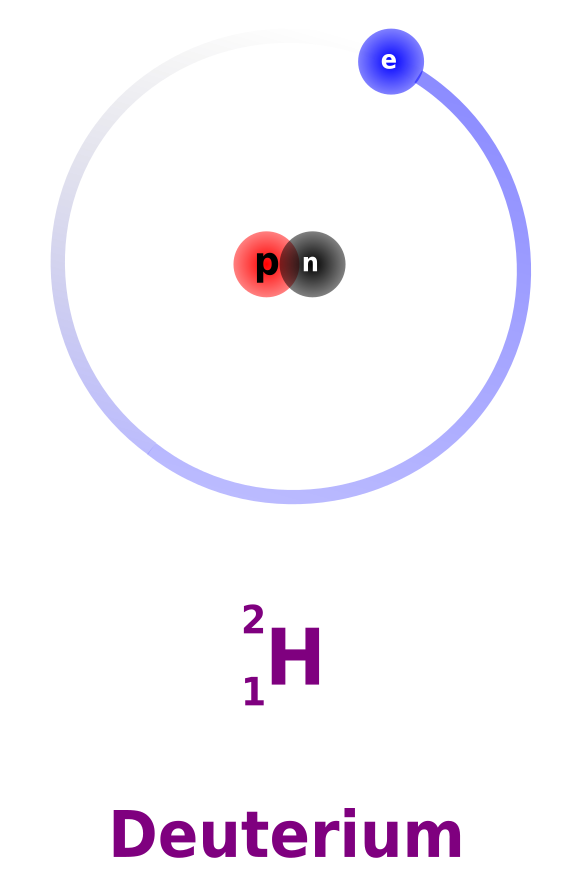
Nuclear Binding Energy : Hydrogen-2 (deuterium)

  • Mass of one deuterium atom: m = 1876.14 MeV

  • Mass of parts :

     neutron (939.57 MeV)

     proton (938.27 MeV)

     electron (0.511 MeV)

     TOTAL : 1878.351 MeV

  • Result : Deuterium mass is 2.22 MeV LESS than the sum of its parts

  • Nuclear binding energy of 2.22 MeV


Deuterium is completely stable.


Neutron Decay

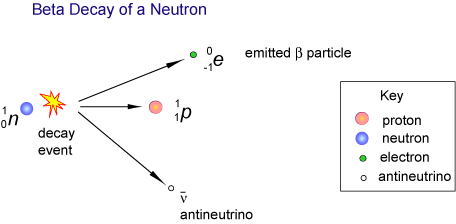
  • A free neutron (outside of a nucleus) decays into a proton, an electron and a (nearly massless) neutrino

  • Mass of one neutron: 1.008665 u

  • Mass of parts :

     One proton (1.007276 u)

     One electron (0.00054858 u)

     One neutrino (nearly massless)

     TOTAL: 1.007824.. u

  • Neutron is HEAVIER than its constituent parts by
    0.000548 u or about 0.78 MeV

(CoE+CoM here implies existence of neutrino)

CoE allows the neutron to decay (and it does, with a half-life of about 610 sec, with this excess energy carried off by the neutrino and the electron)

If the neutron can decay, why doesn't it decay when it's in a deuterium atom?

Suppose the neutron in a deuterium nucleus becomes a proton by emitting an electron (and neutrino). What would the mass of the resulting picture be?

  • Mass of original deuterium atom: 1876.14 MeV

  • Mass of parts in the proposed decay path result:

     proton (938.27 MeV)

     proton (938.27 MeV)

     electron (0.511 MeV)

     electron (0.511 MeV)

     nuclear binding energy: -2.2 Mev

    electric P.E. of two protons 1 fm apart: +1.44 MeV

     TOTAL: 1876.78 MeV

The mass of the atom is about 0.64 MeV less than the sum of its parts. It can't 'decay' this way without an addition of at least that much energy.

Conservation of energy prevents the neutron inside deuterium from decaying


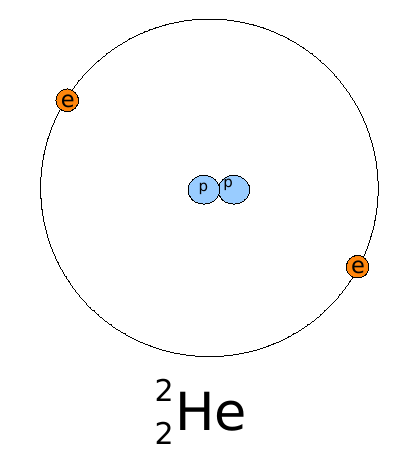
The isotope this 'decay' would yield would have 2 protons and 0 neutrons, making it an isotope of helium.

CoE prevents deuterium from decaying into this isotope, but it has been created artificially.

It's unstable, with a half-life of less than a nanosecond and decays by spitting out one of the protons.


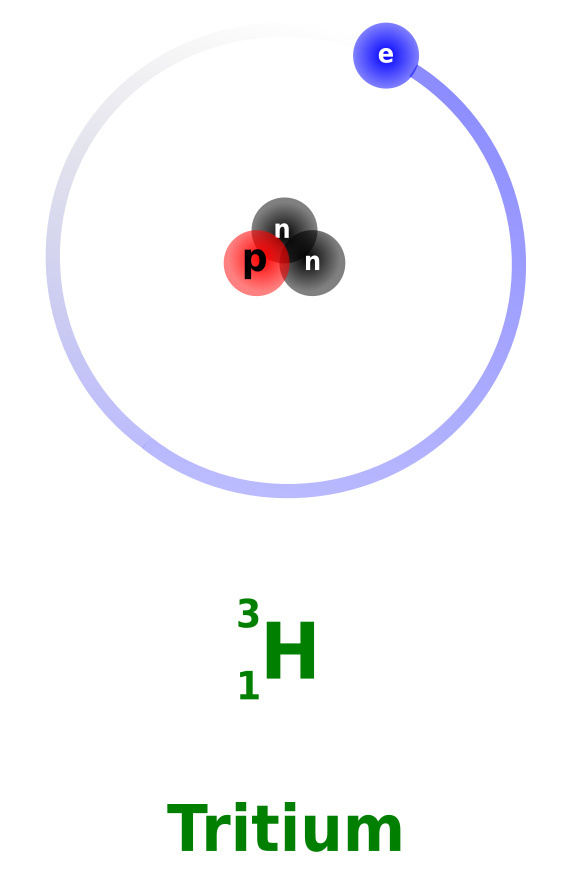
Hydrogen-3 (tritium)


  • Mass of tritium atom = 2809.44.. MeV

  • Mass of parts (p+2n+e) = 2817.4 MeV (higher by about 8 MeV)

  • Apparently about 8 MeV of nuclear binding energy here
    but tritium is not stable

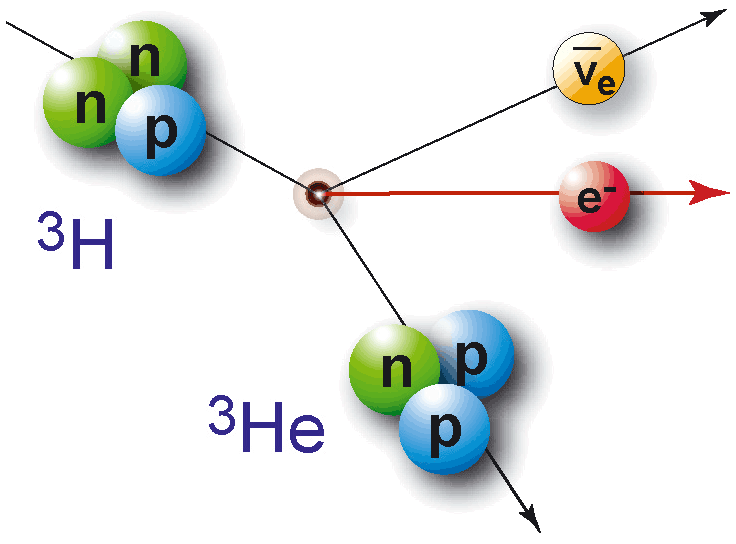
  • Hydrogen-3 (tritium) decays into a helium-3 atom via β- emission
    (basically a neutron decays into a proton)

  • Mass of original tritium atom = 2809.44.. MeV

  • Mass of helium-3 ion plus ejected electron: 2809.43.. MeV

  • Result is about 0.0186 MeV LOWER so CoE allows this decay path

     → He-3 as fusion fuel source

     → decay hinted at existence of neutrino


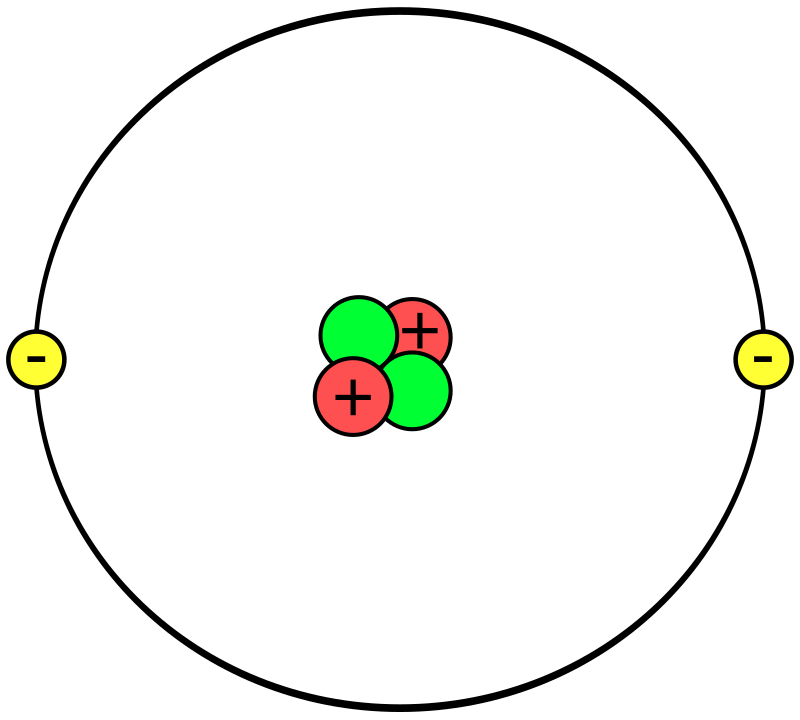
Helium-4

  • Mass of helium-4 atom: 4.002603 u

  • Mass of parts (2p+2n): 4.032980 u

  • Atom is 0.03 u (about 28.3 MeV) less than its parts

  • 28.3 MeV of nuclear binding energy

  • Still might decay IF a path leads to even lower energy though

  • Look at all possible decay paths: all lead to HIGHER energy so:

    Helium-4 is stable


Uranium-238


  • Mass of U-238 atom: 238.058 u

  • Mass of parts (92p + 146n + 92e): 239.98 u (heavier by almost 2 u)

  • Nuclear binding energy: 1863 MeV

  • NOT STABLE though:
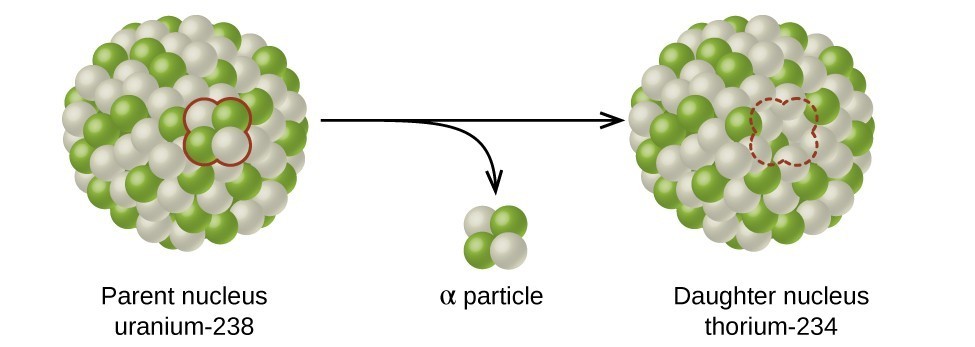
     → U-238 Becomes thorium-234 by emitting an α particle

  • Mass of Th + α = 238.046 u

  • slight mass (energy) decrease so CoE allows path

  • →very long half-life (over 4 billion years)


Binding Energy per Nucleon


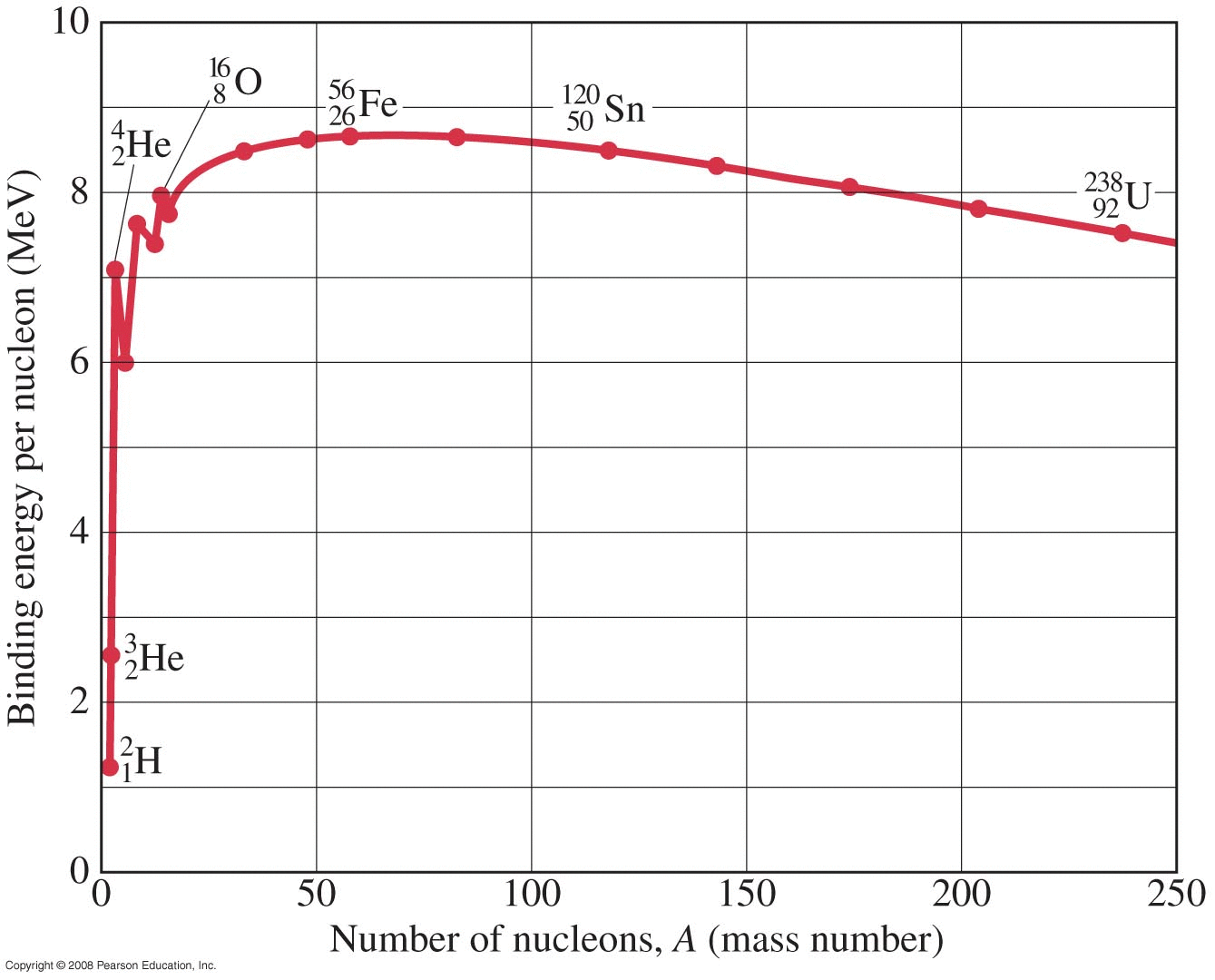
In this graph, the nuclear binding energy (mass of parts MINUS mass of actual atom) is divided by the number of nucleons present.


Graph peaks (highest B.E. per nucleon) at Iron-56


Atoms heavier than this 'want' to move left if possible (radioactive decay modes, where possible)

Atoms lighter than this can reach more stable configurations via fusion


Decay Series


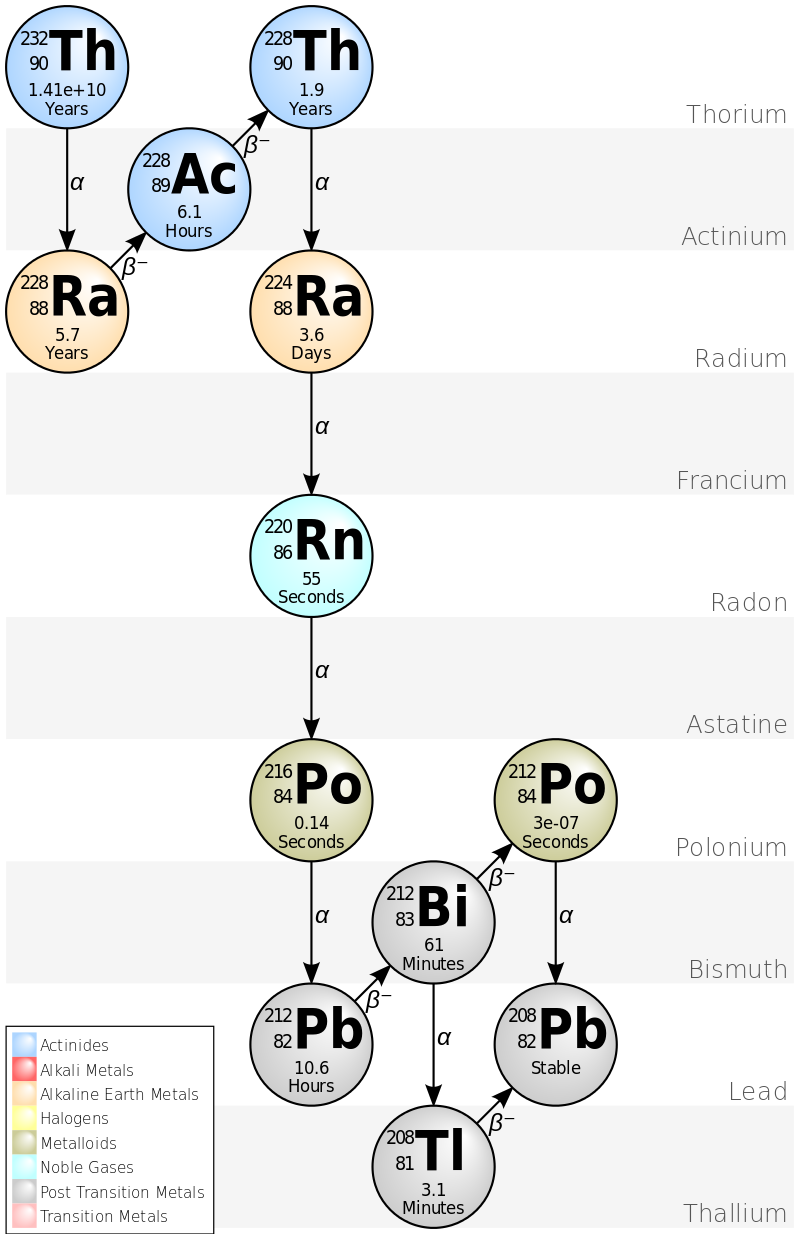
Often, radioactive isotopes decay into other isotopes of other atoms that themselves aren't stable, so they decay into other isotopes which themselves may decay and so on.


These 'chains' are called decay series.


The figure illustrates what happens to an atom of Thorium-232.


Attenuation and Shielding


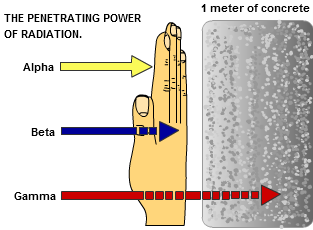
The various types of radiation (α β and γ) are all particles, and those particles will interact with matter (us, or preferably something in between the source and us).

  • α particles are helium nuclei (heavy, slow) and are easily stopped

  • β particles are electrons (light, fast) and are less easily stopped

  • γ particles are mass-less photons (usually high energy) and are harder to stop


Common Units Encountered

  • 1 curie (Ci) is defined to be the activity of 1 gram of radium-226 and is equal to 3.70 × 10¹⁰ decays/sec

  • 1 becquerel (Bq) is the same as 1 decay/sec


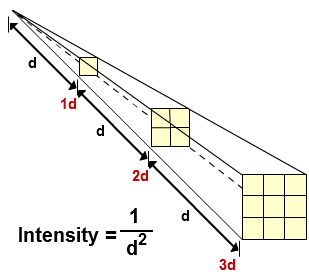
One very effective form of shielding is distance.


As the radiation travels, it is 'spreading out' over a larger surface area


Area is proportional to the distance squared so I ∝ 1/r2

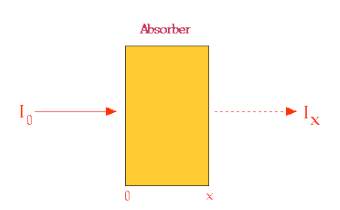
Shielding : All these types of radiation can interact with matter, so another common approach is to just put something else between the source and us to absorb some/most of it.

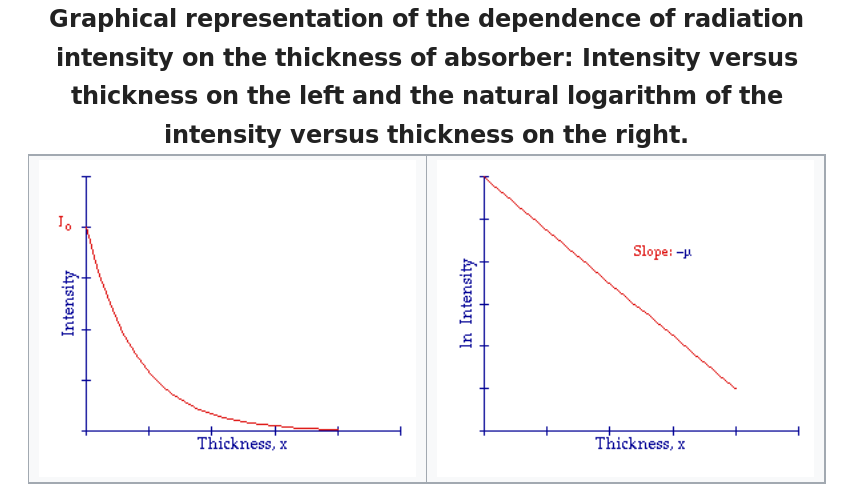
  • Statistical process again

    \[ \frac{\Delta I}{I} \propto \Delta x \]

  • Leads to: I(x) = Io e-μ x

  • μ is called the linear attenuation coefficient
      units of m-1, cm-1, mm-1, etc

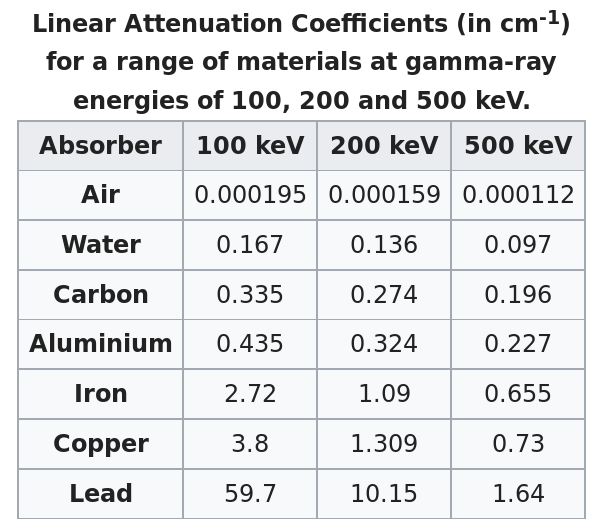
  • Depends on material, type of radiation, energy of the radiation, ... (tables!)

  • Half-value layer (HVL) : thickness needed to reduce intensity by factor of 2

x1/2 = ln(2) / μ


Example : Attenuation


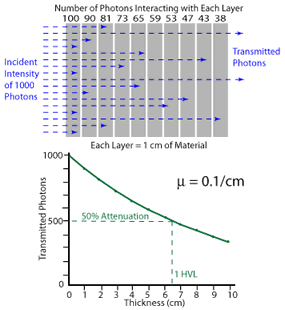
The figure on the right illustrates gamma rays hitting a series of 1 cm thick layers of some shielding material, showing how many get absorbed in each layer.

10 percent (a factor of 0.1) are absorbed in the first 1 cm thick layer, so the linear attenuation coefficient here must be about μ = 0.1/cm = 0.1 cm-1.

If the incoming γ ray intensity is:
  1000 cm-2 s-1

(a) What should be intensity be after passing through the 10 layers shown here?


(b) What is the half-value layer thickness for this shielding material?

Example : Rutherford Gold Foil Experiment


  • α particles from decaying uranium or radium were sent through a very thin sheet of gold foil.

  • Thickness of one sheet of foil: 0.4 microns = 0.4 μm = 4 × 10⁻⁷ m

  • A gold atom has a diameter of about 0.3 nm; how many atoms thick is a single foil?

  • 99% of α particles went straight through.

     (a) Determine the attenuation coefficient μ and the HVL thickness.

     (b) How many sheets of this gold foil would it take to cut the intensity in half?
          (Multiple paths here: μ, x1/2, use the 0.99/sheet directly, ...)

Example : Air as shielding


  • HVL for the α particles above in air is 3.7 cm
     (a) What 'thickness' of air would reduce the intensity by 1000?

  • (We're moving farther away so 1/r2 also reduces the intensity but we'll add that next.)

Example : Air and Distance together as shielding


Suppose we have a small sample of radium emitting 1 μCi of α particles.

The HVL for these α particles in air is 3.7 cm

A Geiger counter is held 50 cm away from the source; the 'business end' (collector) has an area of 5 cm2

 (a) How many clicks/sec would the Geiger counter read if we account for just the 1/r2 spreading?

 (b) How many clicks/sec would the Geiger counter read if we include the absorption in the air?

Example : Paper as Shielding


  • The HVL for α passing through a sheet of paper is 52 μm

  • How many sheets of paper of thickness 0.07 mm are needed to reduce the intensity by 1000?

Beta and Gamma Radiation

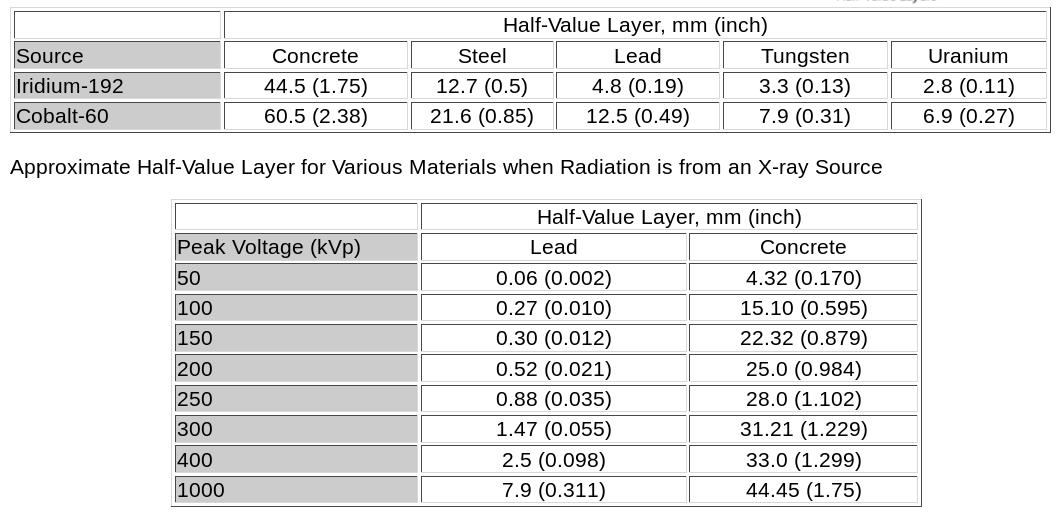
Shielding against these types of radiation is very sensitive to the energy of the β and γ particles.

Table below: HVL's for Beta (upper table) and Gamma (lower table) Radiation at various energy levels:
Example : gamma radiation

Given: Radioactive source emitting 0.1 μCi of 200 keV gamma rays (uniformly in all directions)

 (a) What is the intensity 1 meter from the source? (1/r2 effect)

 (b) The linear attenuation coefficient for gamma rays in air at this energy is μ=0.000159 cm-1   (earlier table)
   By what factor will absorption reduce this intensity? (What is x1/2 here?)
   (We're not getting much help from this effect here...)

 (c) What does adding 1 mm of lead shielding to our clothes do?

 (d) Suppose a source has the same intensity but is emitting 400 keV gamma rays?